Water, water, everywhere, nor any drop to drink…

Coleridge’s mariner was damned for needlessly shooting an albatross. Toledo however, is bringing on its own destruction by inaction, despite warnings months ago from the Federal EPA. In the small hours of the night, ten days ago, an automated emergency phone call woke us to tell us not to drink the tap water. The annual algae bloom in Lake Erie this year had become too strong, right at the water intake pipe for Toledo’s (and Perrysburg’s) municipal water systems. This satellite view shows the western end of Lake Erie seriously compromised.  Toledo and the Maumee river are at the bottom left corner:
Lake Erie Blook_2144
For three days we were forbidden to drink the water, wash dishes (unless rinsed in afterwards in ‘clean’ water) or even to spray municipal water on leafy vegetables in the gardens.
The algae is an interesting bright green living slime. Its growth in the lake is accelerated by summer warmth and the excess nutrients (Nitrogen and Phosphorus) from fertilizer runoff from farms and riverside gardens. Heavy rainstorms can also overflow the waste water pipe system, dumping untreated sewage into rivers and lakes which add food to the algae.
The algae produces a harmful non-living, long lasting, stable toxin called microcystin. It cannot be destroyed by boiling and is too small to physically filter out, other than by Carbon filter absorption. It is odorless, colorless and tasteless, but is harmful because it accumulates in one’s liver, according to the World Health Organization (WHO) (it sounds incredible enough to be a story from the famous BBC TV sci-fi Doctor of the same name) in concentrations greater than 1 ppb (part per billion).
Microcystin is incredibly old. It evolved, with cyanobacterial algae blooms about 3 billion years ago, perhaps as a protective agent for the algae, but protecting against what we do not know – back then there were no animals in existence to eat the algae. The toxin might have been protecting it from solar UV according to today’s (2014/8/12) NYT Science section. The blooms themselves were vital to us then as they were the early creators of Earth’s Oxygen.
Our numerically challenged news reporters erroneously had it measured as “1 or 2 ppm” (parts per million) instead of ppb (parts per billion) for a while. But, understandably, it is hard to appreciate that a substance naturally produced in our lovely lake could be seriously harmful in concentrations above one drop per tanker rail-car full (300,000 gallons). But watch out for the numbers: while a limit of 1 (ppb) (parts per billion) could sound reasonable, would you accept the same level as safe if it was just as honestly, but more scarily, called 1000 ppt (parts per trillion)? No matter how you quantify it, it is truly wonderful that we can detect and measure such miniscule amounts. Such skills can save us, if only we can properly interpret the values and apply them appropriately.
Back in Perrysburg we had the interesting situation of water seemingly everywhere, yet unusable:
1. A live river full of slightly muddy water: the Golden Maumee.

River Kayak_3941
2. Clear, tasteless, odorless water in the taps, and a few recent gallons in spare storage in jugs in the basement, but who knew how far back the ban applied?
3. And my three 40 gallon full rain barrels (for plant watering) collected from clear and pure (well perhaps a little acid rain, moss spores, bird bits, etc.?) rain water from the roof.
Rain Barrel_2221
I was unable to interest any of the house residents (other than the quasi-dumb animals) in that toxin-free roof water, even when I offered to boil it.
Sold out signs appeared within hours, for a radius of at least 20 miles, in stores selling any type of bottled water. But friends visiting from out of state all brought gallons in plastic jugs and bottles.

The water is back on for now, and we have a stock of ‘plastic’ water to be drunk within the next 12 months as the bottles have “Use by…” dates of 2015.
Water bottles_2289
What happens, over time, to water in a plastic bottle?  I’m sure I could happily live on honey, beer and coffee made with skim milk, but dry cleaning one’s teeth is difficult.

Nobody said it would be easy but we do need to look after our planet. At least now we can measure the invisible toxins before they do too much harm. But sometimes even the very visible seems to be too hard to fix. For years Toledo and Perrysburg have been trying to prevent sewage overflows in heavy rains. Yet yesterday, 8/11, we had about 3 inches (75 mm) of rain which resulted once again in the following overflow damage to Water Street and hence, the river and the lake:
Overflow_2284

Electric Toys for Boys (& Girls)

You know the sexist saying: “The difference between the men and the boys is the price of their toys”? Well here are six of my recent favorites, ranging in cost from tens to tens of thousands of dollars:

1. “Nissan Leaf”
We’ve now driven 7500 miles in this all-electric car without an oil change or any maintenance – there is nothing under the hood to maintain!
New Leaf
We plug in to a 110 Volt outlet at home in the evening and for about $3 worth of power, we can drive 100 miles the next day at any highway speed allowed and with the great acceleration that the high torque of an electric motor can provide.
The plug-in socket seems to be sufficiently weatherproof for outdoor connections but I don’t leave it connected in violent thunderstorms.
Plugged in in Snow
The big fun part is plugging into public outlets at pay-parking spots where the power is included:
Toledo Charging
Or even better, after hours with free parking, or at The Toledo Museum of Art and a few other noble institutions, where the power is not only totally free, but with their 240 Volt systems the charging speed is much greater.
Sometimes you get to the spot shown in your iPhone ap only to find it occupied – but if it’s by as sleek a car as this Tesla (with 195 miles charge showing on the instrument panel) in ‘our’ spot in Bowling Green last week then it’s hard to complain:
Tesla in BG_0737
Perhaps there really is a “free lunch” after all!
The Leaf is not quite as useful as my old gas-drinking Merc. for carrying my water toys but that’s a separate issue.
Merc with roof load
On Scott’s suggestion, I was surprisingly able to slip the Prodigy windsurf board, sail and two piece mast completely inside the leaf.
Prodigy in Leaf_0778

2. “WinBot”
This device improves on the horizontal running Roomba floor vacuum robot, by sucking onto a vertical flat glass surface with a slippery silicon suction cup.
Windbot_0766
High friction caterpillar tracks drive it across the glass and micro fiber pads wash and wipe it clean. It runs around from edge to edge and corner to corner on its own program, or for fun with kids they can steer it through the window with a remote controller.
Obviously much valued for difficult to reach glass.
Ladder to Windows_0746 - Copy
Winbot

3. “iPhone with ōlloclip” Macro Close-up Attachment.
(OK it’s not exactly an electric toy but it does fit on my electric iPhone which still amazing works after being dropped from 4 ft. (over 1 m) into a shallow puddle!)
Olloclip on iPhone
This little clip-on device allows you to go from this close with your standard iPhone when it is set on max. zoom:
Midge in Macro
to this close:
Midge with Olloclip
Please note: no midges were harmed by the photographer in the preparation of these images! The first one simply flew away, and the second one was removed, dead, from a spider’s web – much easier than trying to actually catch one with a net. You can see the scale by appreciating that the wooden stick is the tip of a tooth pick. The midge is only about 2 mm (1/16 inch) long. I’d like to know its name if you have it?

4. “CritterCam” (or “Trophy Cam”)
CritterCam 609 - Copy
Here is the best night time photo, so far, from six months up a tree on the wild life corridor, down by the Maumee River. The camera is triggered by the Infra Red heat of a creature and takes pictures every 10 seconds until it goes away: night time roaming of the coyote – looking for stranded skiers?
M2E1L0-0R350B300
Naturally, I now also have a few thousand daytime images of squirrels and geese. In Owen Sound, Ontario, my friend Brian’s CritterCam caught this porcupine:
Brians Porcupine - Copy
He is still trying to get the cougar who’s footprints he has seen in the snow.

5. “GoPro”
This amazing waterproof camera, clipped to the boom of a windsurfer, took the videos seen in previous years’ Cape Hatteras blog postings.

With a head harness,GoPro Head Cam_0862 - Copy
it will easily record cross country ski trails (see past winter blog posts) and anywhere else a head is foolish enough to venture, as in the recent May New Yorker magazine cartoon:
New Yorker GoPro

6. “The Drone”
The most awesome toy is the combination of a GoPro camera with the DJI Phantom II QuadCopter drone.
Johns Drone_0652 - Copy
The proportional controls (not simple on/off switches) are three separate joy sticks on the one flight and photo command box. Simply releasing the controls returns them all to a neutral hover mode so it is not impossibly difficult. The drone uses compass, altitude and GPS readings to control itself, and can beam live video back to an iPhone if you need!
Architectural photographer John Muggenborg cautiously allowed me to take the controls during this ‘surveillance’ flight of Manhattan from Fort Greene in Brooklyn, but I take little credit for the following video.
http://youtu.be/eGD7ET6bhJY
John’s great real work is well worth seeing at www.johnmuggenborg.com

Be Careful What You Fish For

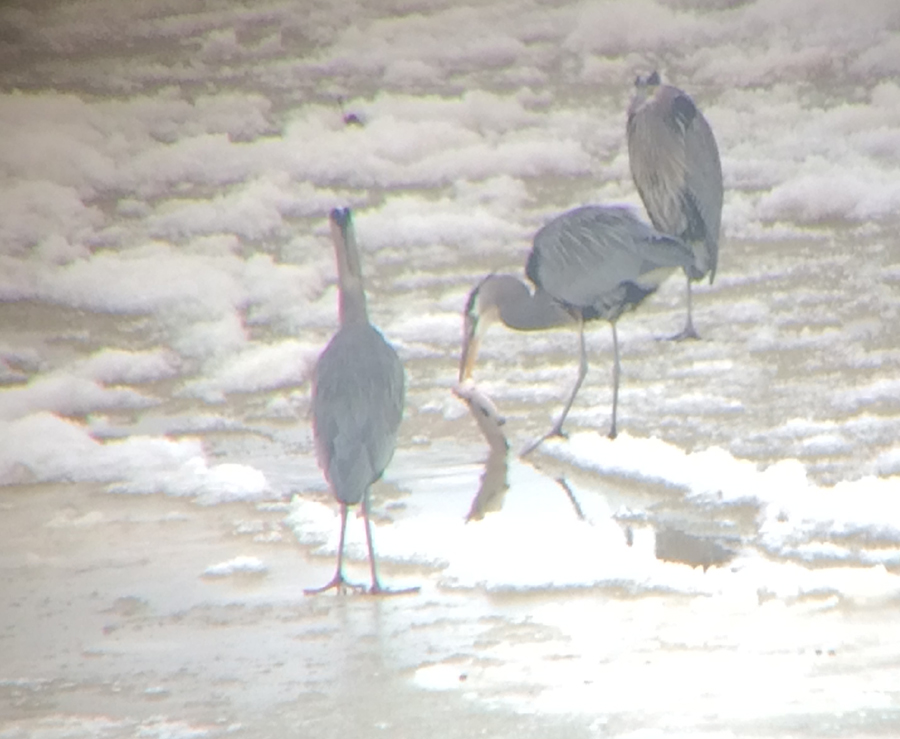
The Great Blue Herons are hungry. They hang out on the river ice at the last spots of open water, wishing for a fish. One somehow landed this one – far too large to swallow

Fish catch

Too big to swallow
and too tough to be pecked open with its beak.
All the birds offered to help – they chased each other around, through the gardens, but they never found out how to eat it.
Chase 9499

Flight_9501Snow at 341_9185

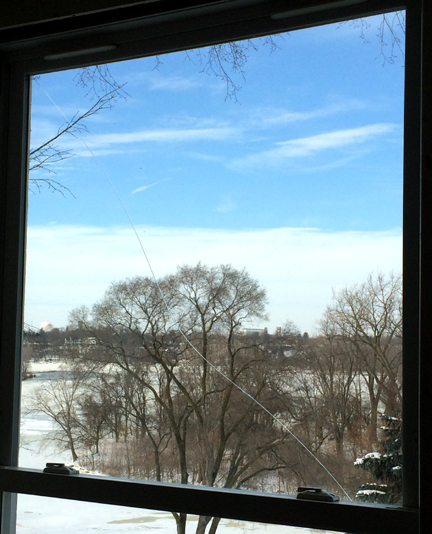
I had wished for more snow than last year when I barely got 13 days of X-Country skiing here, some of that only at night. This winter there’s been much more snow; great for skiing once the shoveling is done. So far we’ve skied from the end of December to mid February.Top Sash Broke_9157

I did not wish for the extreme cold that came with the snow. The press blames a newly (for them) discovered Polar Vortex, but I see more association with the still poorly explained Jet Stream.
At -4°F (-20°C) the cold contracted the air in one of my new (well, 5 yrs. old) sealed double glazed windows so much that it ran a miniscule crack that that had lived harmlessly in the top left corner from the day it was made.

Taking the glass out of the sash revealed the result of a hard-body impact (see the red arrow) at the top left corner.Impact from Left Corner_9427


It had made the original small crack (hard to see), only 1 x 1 x 25 mm (1/32” x 1/32” x 1”) long, but the crack tip never ran out to the glass edge, it just waited for future stresses. The final long, very visible diagonal crack in the window is all too familiar to me. Have you ever seen it? Glass people often blame the cold – but winters are naturally cold. The real problem is that cracked glass is weak. It’s not Mother Nature’s fault. Don’t blame your mother! It’s the fault of whoever or whatever bumped that corner. The cold, plus a high barometer would only create about 500 psi tensile stress by bending the glass. While good glass, with no cracks, can resist 2,000 or 3,000 psi. The makers, Simonton Windows, were extremely gracious and prompt in providing a free warranty replacement in just 2 weeks. In return I sent them a detailed fractographic report. Wonder what they’ll make of it?
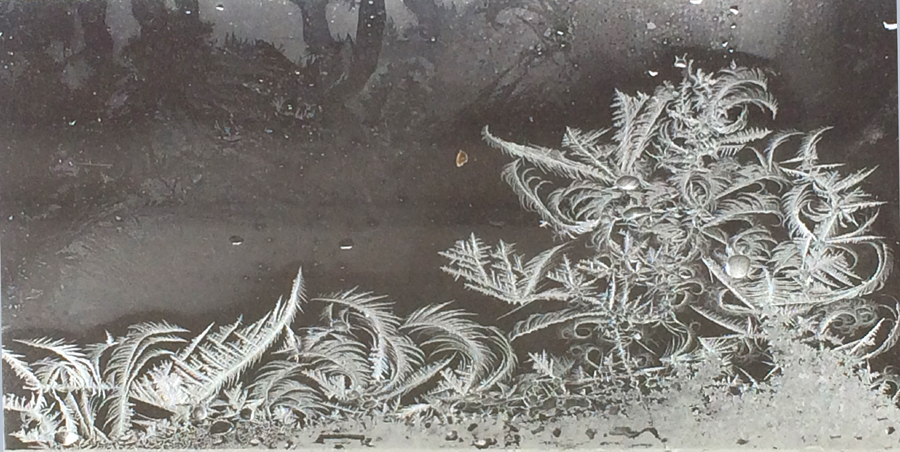
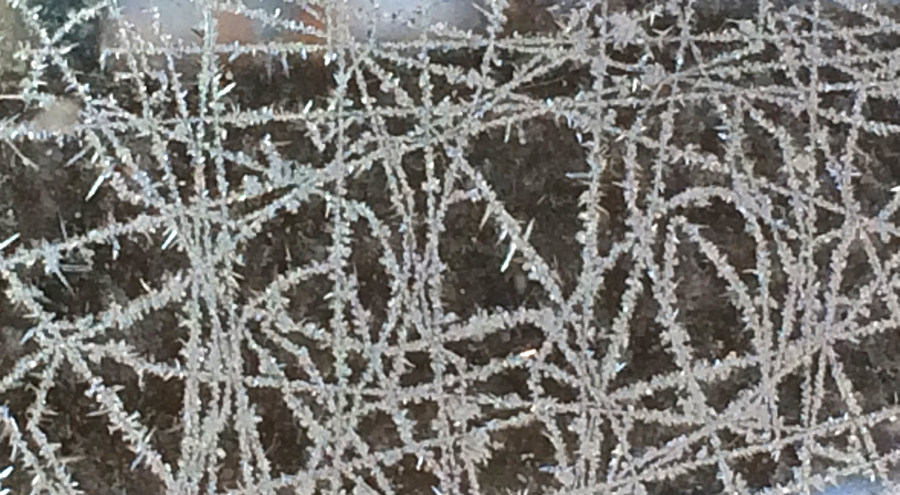
There must be some relationship between glass fracture patterns and ice crystals?Flower Crystals_9401Horiz st line crystals_9553
Close  up crystal_9416This 200 mm (8”) wide crystal is beautiful. With my new ōlloclip macro lens on the iPhone it looks at just a 3 mm (1/8”) wide slice and shows even more, fractal-like exquisite detail.
I always wonder how some of the frost lines can often be so straight?
Tree icy_3377River side crystals

Sometimes it is so cold: -4F (-20C) that the very air itself seems to freeze on the branches.

I looks very dramatic when the sun shines.Raccoon_9164

The animals are frozen and hungry, and turn up in odd places along my ski trail:
This young raccoon had no visible damage, but lay very quiet on my ski trail. Next day it had moved under a nearby house and after that it could not be found.

This heron was frozen stiff and could barely move.Heron in the woods_9418


Even the two eagles seem to huddle together for warmth.Eagles together_3371Thirsty squirrel_9454
Alice n Squirrel_3367Alice grudgingly lets the squirrel eat spill-over from the bird feeder. Later the squirrel tries to drink water but doesn’t seem to know that the river is frozen.
However the dove is fat and happy.

Fat Dove_9559

Some say it’s wrong to feed the birds but who can resist with birds like thisIMG_9213


Meanwhile the ground hog insists on eating our expensive native grasses and Golden rods – not surprising I guess!
But my new GoPro camera, on a head mount, records the happy parts in exquisite detail. This following long video is an edited version of yesterday’s very fast 47 minute run around the Water Street Wild Life Loop. I’m embarrassed about the spills: the trail was not stiffly frozen and the snow beside it, which used to be as light as smoke, is now heavier and readily grabs an errant ski, with unfortunate results for the unwary.


Water Street Wildlife Trail. 20 mins.